Keeping Children Safe and Secure!
The Car Seat Program at Sullivan County Department of Public Health highlights the importance of safe car seats and proper installation.
Our New York State Certified Car Seat Technicians are available by appointment for car seat checks and installations.
Bring with you:
- Current car seat and child using it
- Photo ID
Please call 845-292-5910 ext. 0 for appointments or more information.
All appointments are held at the Public Health building: 50 Community Lane, Liberty, NY 12754
Qualifying Sullivan County residents may be provided with a new, unused car seat.
Infant car seats may be provided to qualifying, expectant mothers 1 month before their due date. We are not able to provide last minute car seat installations for people who have already delivered and whose infant cannot be discharged from the hospital without a car seat. Please plan ahead by calling us before your due date
This program is made possible by the New York State Governor's Traffic Safety Committee (GTSC) grant. Together we can improve safety and reduce serious injury or death or children due to car accidents!
FAQs
When can my child stop using a booster seat?
- Your child must be 8 years old and be able to sit with their back straight against the vehicle seat with their knees comfortably bent. It is recommended that children remain in their booster seats until they are 4 feet 9 inches tall, or weigh 100 pounds.
How do I qualify for a new car seat through the Department of Public Health?
- To qualify you must be a Sullivan County resident and be receiving social assistance services. Please call us for more information on eligibility: 845-292-5910 ext. 0
If I already have a car seat, can I still make an appointment for a car seat check?
- Yes! If you have a car seat already and want to make sure it has been installed correctly, please reach out and schedule an appointment with us.
NEW YORK STATE'S CHILD RESTRAINT LAW
Child Passenger Restraints Are Not An Option, They Are The Law!
- All children must be restrained in an appropriate child restraint system while riding in a motor vehicle until they reach their 8th birthday.
- A child restraint system may be a child safety seat, harness, vest or a booster seat.
- An appropriate child restraint system is one that meets the child's size and weight recommended by the manufacturer.
- The vehicle's safety belt alone is NOT a child restraint system.
- The safety belt in your vehicle is not designed for children. A booster seat raises your child up so that the safety belt fits your child correctly and provides better protection.
- Booster seats MUST be used with a lap and a shoulder belt.
Effective November 1, 2019, the law states that all children under the age of 2 must ride in a rear-facing car seat. There are 2 types of rear-facing car seats: Infant Seats and Convertible/All-in-One Seats.
For more information see New York State's Child Passenger Safety page or visit the National Highway Traffic Safety Administration's page on Car Seat and Booster Seats.
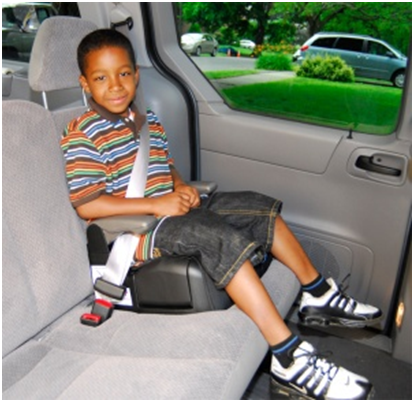
Children 12 years and younger should ride in the back seat. The simple task of properly buckling up children in the back seat reduces the risk of being killed in a crash by 33%.
Wondering when to move your child from a booster seat to vehicle seat belts? Make sure that your child meets all of the following requirements for a proper seat belt fit:
1. Your child must be 8 years old.
2. Your child should be able to sit with his or her back straight against the vehicle seat back.
3. The knees bent comfortably at the seat's edge without slouching.
4. The lap belt should be low across the upper thighs or hips, not across the abdomen.
5. The shoulder belt should lie across the chest and shoulder, not touching the neck or face.
6. Your child should be able to ride this way for the entire trip.
7. It is recommended that booster seats be used until your child is 4'9" tall or weighs 100 lbs.
Think Safe, Ride Safe, Be Safe! Buckle Up Every Time!
Car Seat Recommendations for Children
- Select a car seat based on your child's age and size, and choose a seat that fits in your vehicle and use it every time.
- Always refer to your specific car seat manufacturer's instructions; read the vehicle owner's manual on how to install the car seat using the seat belt or LATCH system; and check height and weight limits.
- To maximize safety, keep your child in the car seat for as long as possible, as long as the child fits within the manufacturer's height and weight requirements.
- Keep your child in the back seat at least through age 12.
STEP 1: Birth - up to 2 years
Effective November 1, 2019, the law states that all children under the age of 2 must ride in a rear-facing car seat. There are 2 types of rear-facing car seats: Infant Seats and Convertible/All-in-One Seats. Infant car seats can only be used rear-facing. Convertible and 3-in-1 car seats typically have higher height and weight limits for the rear-facing position, allowing you to keep your child rear-facing for a longer period of time. Keep your child rear-facing as long as possible. It's the best way to keep him or her safe.
STEP 2: 2 - 3 years
Your child should remain in a rear-facing car seat until he or she reaches the top height or weight limit allowed by your car seat's manufacturer. Once your child outgrows the rear-facing car seat, your child is ready to travel in a forward-facing car seat with a harness, usually around age 2.
STEP 3: 4 - 7 years (up until the child's 8th birthday)
Keep your child in a forward-facing car seat with a harness until he or she reaches the top height or weight limit allowed by your car seat's manufacturer. Many new seats on the market can now accommodate children to higher weights and heights. Once your child outgrows the forward-facing car seat with a harness, it's time to travel in a booster seat, but still in the back seat. Always use both the shoulder and lap belt every time with all booster seats.
NYS law requires that all children must use an appropriate child restraint system until their 8th birthday, however many children are not large enough by age 8 to begin using the adult seat belt.
STEP 4: 8 - 12 years
Keep your child in a booster seat until he or she is big enough to fit in a adult seat belt properly, For a seat belt to fit properly the lap belt must lie snugly across the upper thighs, not the stomach. The shoulder belt should lie snug across the shoulder and chest and not cross the neck or face. Remember: your child should still ride in the back seat because it's safer there, always using BOTH the shoulder and lap belt.
DESCRIPTION OF RESTRAINT TYPES:
- A REAR-FACING CAR SEAT is the best seat for your young child to use. It has a harness and in a crash, cradles and moves with your child to reduce the stress to the child's fragile neck and spinal cord.
- A FORWARD-FACING CAR SEAT has a harness and tether that limits your child's forward movement during a crash.
- A BOOSTER SEAT positions the seat belt so that it fits properly over the stronger parts of your child's body.
- A SEAT BELT should lie across the upper thighs and be snug across the shoulder and chest to restrain the child safely in a crash. It should not rest on the stomach area or across the neck.