Be prepared. Be trained. Be the difference.
Naloxone (Narcan) is a safe, easy to use medication that can reverse an overdose by restoring normal breathing in someone whose breathing has slowed or stopped due to opioids.
Our prevention program provides free trainings, Narcan kits, and refills to anyone in need or interested in learning more about overdose prevention.
Please give us a call at 845-292-5910 ext. 0 or email us at PublicHealthEducation@sullivanny.gov to set up a training.
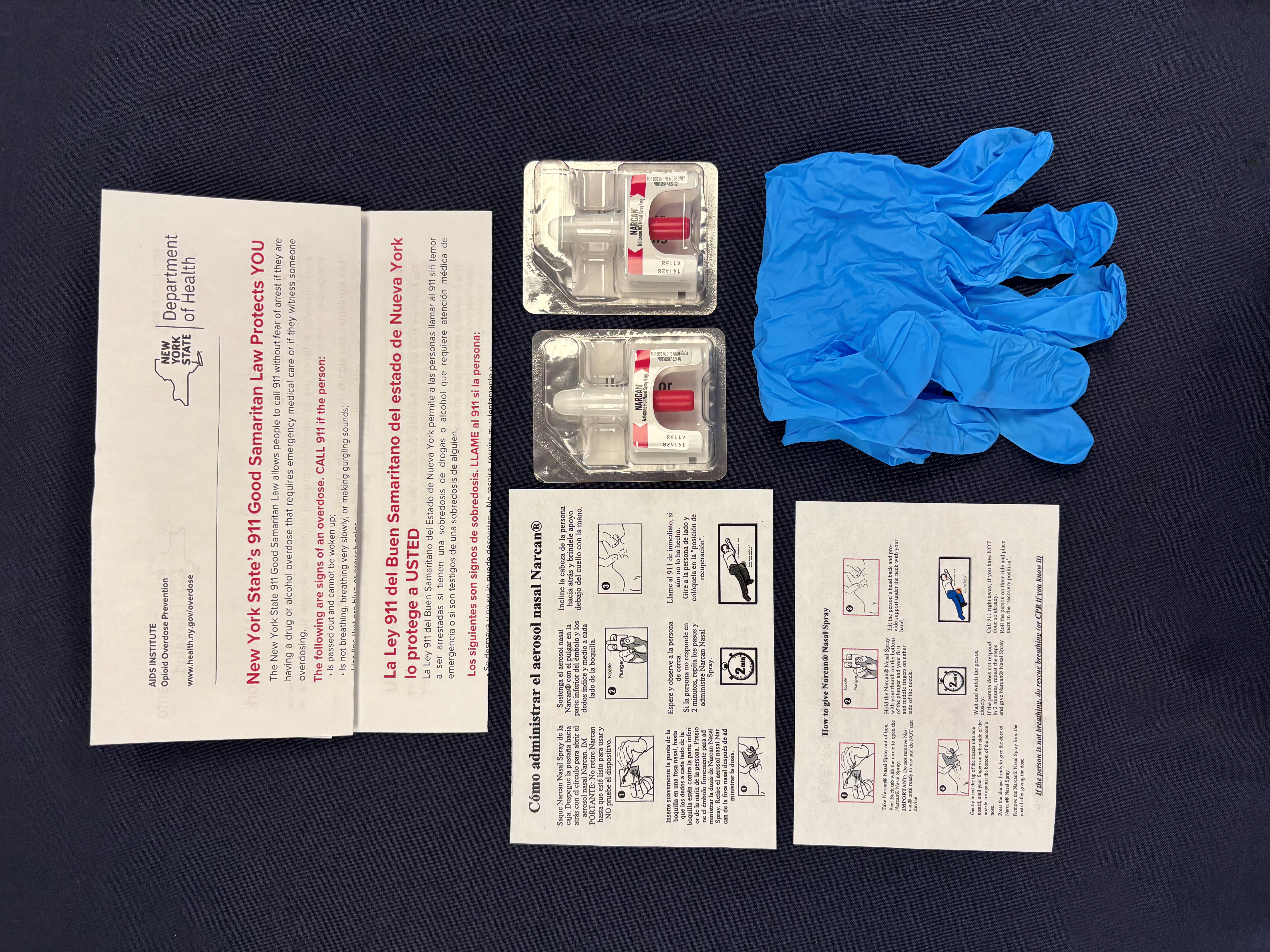
Included in a Narcan kit are 2 doses of 4mg naloxone, gloves, a "How to Administer" card, and information on the Good Samaritan Law.
Kits available in both English and Spanish.
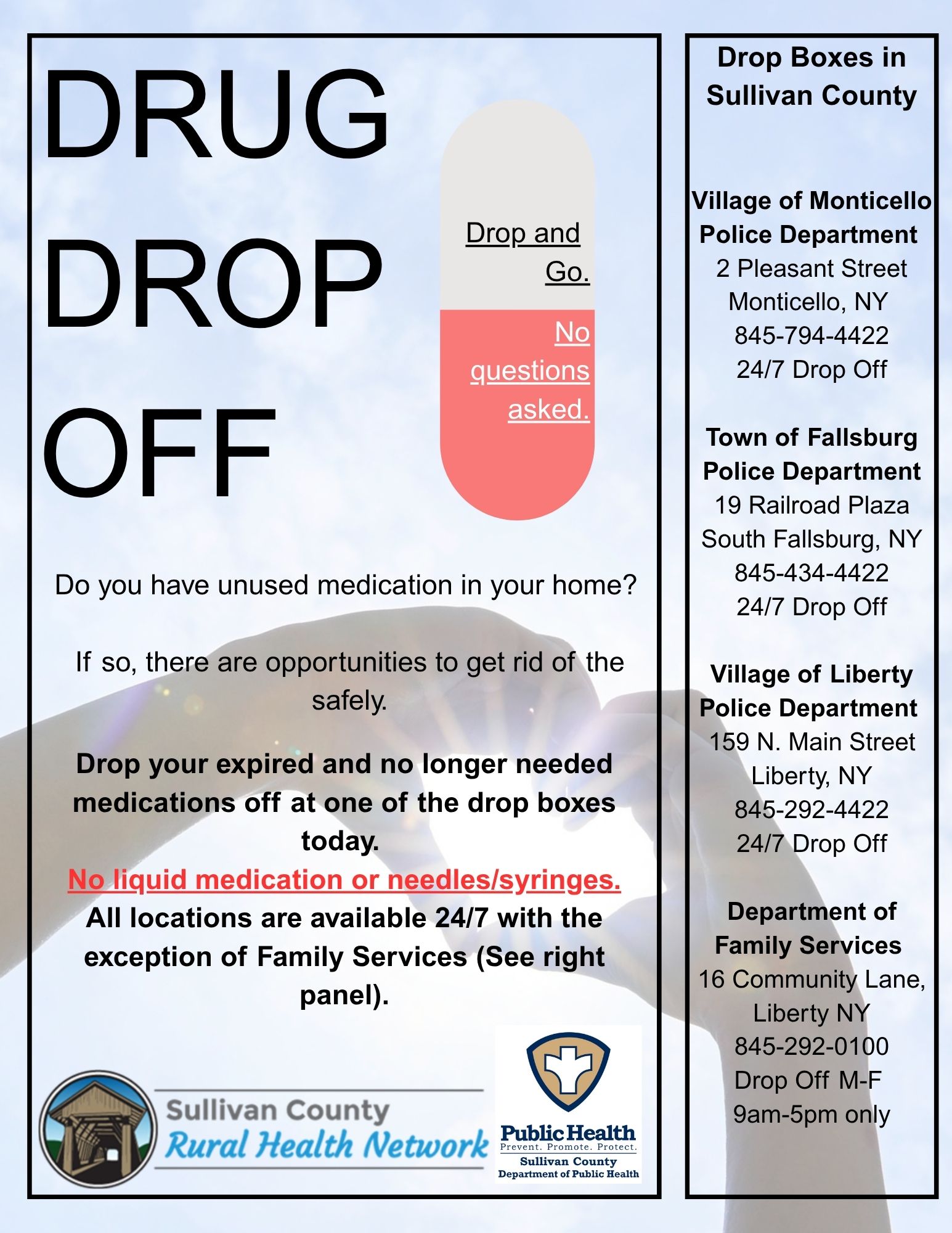
Sullivan County Pharmaceutical Drug Drop-Off Box Locations:
_____________________________________________________________________________________________________________
Hope Not Handcuffs
Anyone seeking help fighting substance use disorders may come to any local police station and ask for the ‘Hope Not Handcuffs’ program. Everyone will be treated with compassion and respect, while a call will be made to an ‘angel’ volunteer from the Hope Not Handcuffs – Hudson Valley team who will actively seek out a treatment plan. For more information, stop by your local police station, call 833-428-HOPE or visit https://www.tricountycommunitypartnership.org/hopenothandcuffs
Angels Wanted
Hope, Not Handcuffs – Hudson Valley is also seeking volunteer “angels” specifically for Sullivan County. “Angels” are people who help participants complete paperwork and place a call to the appropriate provider for treatment assistance.
Meetings are safe and always take place at a participating police station. Once a treatment option is found, transportation is arranged.
Volunteers pick their “on call” days and hours, after they have completed training. For more info and to apply, visit https://www.tricountycommunitypartnership.org/hopenothandcuffs.
Sullivan County Community Services is now offering Medication Assisted Treatment. For more information, click here
What is an Opioid?
Opioids are substances derived from the opium poppy that are primarily used to treat pain. They work by altering an individual’s perception and tolerance to pain; however, they can become addictive. Many individuals who experience chronic pain take legally prescribed opioid medications to manage their pain. There are also illegal forms of opioids that are used by some individuals for recreational use. Examples of opioids include:
- Oxycontin
- Oxycodone
- Morphine
- Demerol
- Heroin
- Methadone
- Fentanyl
*One major detrimental effect of excessive ingestion of opioids is respiratory depression. The medications, in large quantities, interfere with a person’s breathing, resulting in death or brain damage from lack of oxygen.
The Epidemic of Overdose
Throughout the United States, the use of opioid medications has increased dramatically since 1999 in an effort to better manage chronic pain. The unintended effect of this has been an increase in the number of opiates that are available for use both legally and illegally. Substance use rates have risen significantly and with that, the rate of mortality from drug overdose related to these medications. In the United States, approximately 145 people per day die from opioid overdose.
Reducing the Mortality Rate: Registered Naloxone Training Program
To combat the problem, Sullivan County Public Health became a Registered Opioid Overdose Prevention Program in 2014. The program allows for accurate data gathering related to the overdose epidemic in Sullivan County, NY, training programs specific to the area of expertise of the responder, and distribution and monitoring of naloxone, a medication that serves as an antidote to opioids. The naloxone works by pushing the opiate off of the receptor site in the brain.
No Needles Approach
This training provides the responder with valuable information regarding the risk factors for overdose, recognition of an overdose, how to respond to an overdose situation, and hands-on training with the naloxone device. Naloxone can be administered in a number of different forms. For this program, intranasal naloxone was selected due to the reduced risk of exposure to needlesticks that could potentially occur using the other administration methods. Research indicates that intranasal naloxone is absorbed very quickly and is as effective as other methods of administration in reversing an opioid overdose.
Community Training / Additional Initiatives
- Sullivan County Substance Use Task Force
- United Sullivan | NaloxBox Map
BACK TO TOP